
3D Floor Plan Rendering Services USA
Photorealistic 3D Floor Plan Rendering by RenderLand
Your listing is losing clicks to the competitor two doors down who has a furnished, proportionate, fully annotated 3D floor plan Rendering Services. Your developer pre-sale pack is asking buyers to commit from a schematic unit layout. Your client is sitting across the table, looking at a set of architectural drawings, and cannot picture the room you have designed. All three problems have the same solution.
RenderLand produces photorealistic, furnished, and fully annotated 3D floor plan Rendering services for real estate agents, developers, architects, and interior designers across the United States. Not 2D blueprints. Not CAD exports. Not schematic diagrams. Accurate, market-ready 3D floor plan rendering that transforms an architectural drawing into a spatial communication tool any buyer, investor, or client can immediately understand.
Our 3D architectural floor plans are used in Zillow and Realtor.com listings, developer pre-sale brochures, investor information memoranda, planning board submissions, and interior design client presentations. We accept every file format from construction-ready Revit models to hand-sketched room measurements. If your project needs a floor plan that works, this is where to start.
What Is a 3D Floor Plan Rendering Service?
A 3D floor plan rendering service is a visualization service that transforms 2D architectural drawings or CAD plans into realistic, three-dimensional images. These renderings help people better understand the layout, dimensions, and flow of a property before it is built or renovated. It is produced from CAD drawings, Revit models, PDFs, or hand-sketched measurements. It shows room layout, furniture placement, spatial proportions, and material finishes in a format that any viewer can immediately understand without architectural training.
Three formats are commonly confused with 3D floor plan rendering, and each is a different product. A 2D CAD plan is a technical document that requires spatial literacy to interpret accurately. Most buyers, investors, and planning reviewers do not have that training. A virtual tour is an interactive, navigable 3D environment that requires a software platform or device to experience. A full interior rendering is a camera-level perspective image of a single room, not a plan overview of the whole space.
A 3D floor plan Rendering sits between these formats. It communicates the full spatial logic of a property in a single image that can be uploaded to a listing portal, dropped into a brochure, embedded on a website, or printed on a sales center display wall without any specialist software or hardware requirement.
RenderLand's 3D floor plan rendering service covers two primary use contexts. The first is property marketing: real estate listings, developer brochures, and investor decks. The second is design and planning communication: client sign-off, HOA submissions, and planning board applications. Every floor plan we deliver is accurate, branded, and supplied in every format required for marketing, print, and web deployment.
| 3D Floor Plan | 2D Blueprint | Virtual Tour | |
|---|---|---|---|
| Audience | Everyone | Trained professionals | Self-navigating viewer |
| Input needed | Drawings, PDFs, or sketches | Full technical drawing set | 3D model or scan |
| Best use | Listings, brochures, planning, sign-off | Construction documentation | Website exploration, remote buyer engagement |
| Platform req. | None — works on every channel | None — but requires training to read | Browser, app, or VR headset |
RenderLand offers all three formats. At brief stage, we advise on which format best serves your specific project, audience, and distribution channel.
3D Floor Plan Rendering Styles and Output Formats RenderLand Produces
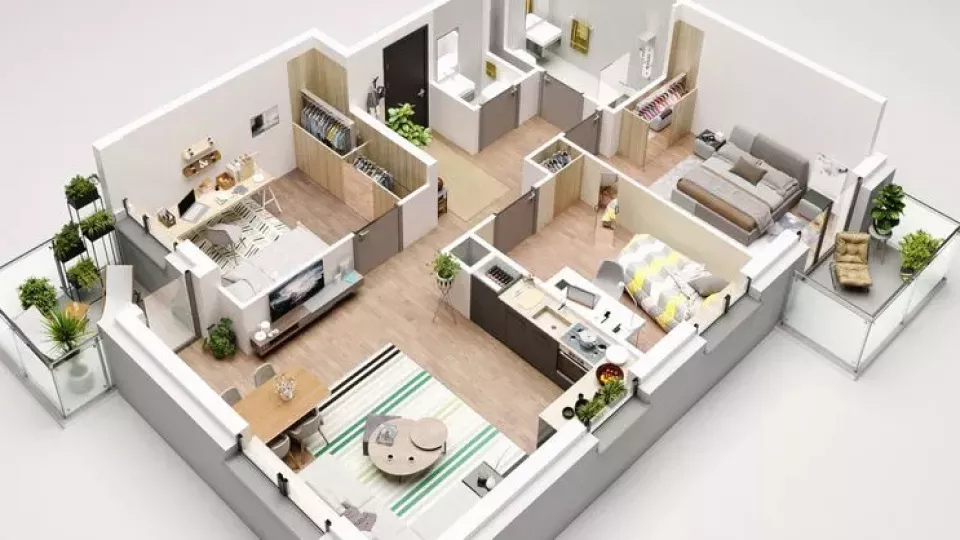
Isometric 3D floor plan rendering present the space in a tilted axonometric view that communicates both layout and spatial volume in one image. They are the standard choice for luxury brochures and premium marketing packs where visual impact matters as much as information density.
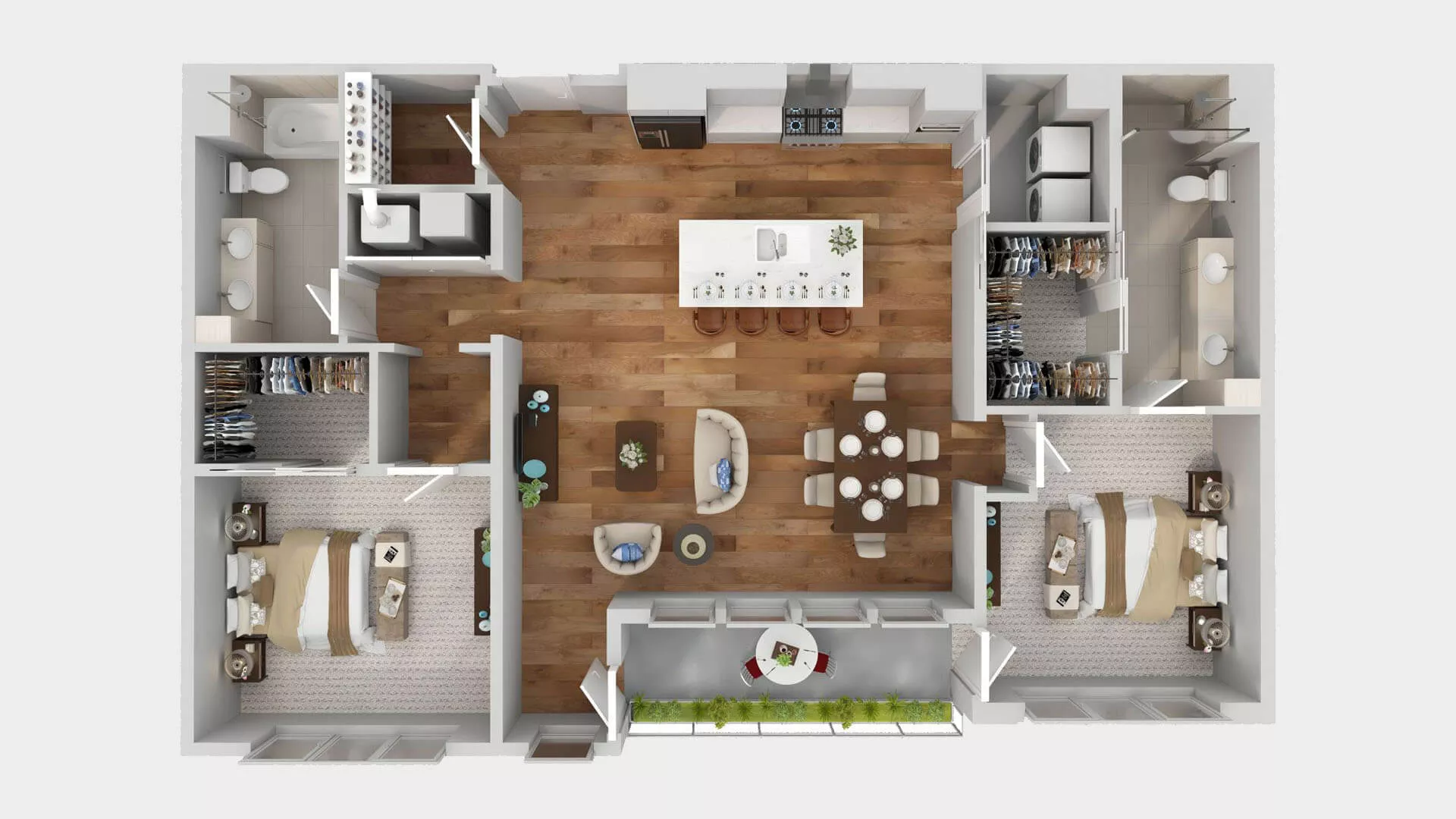
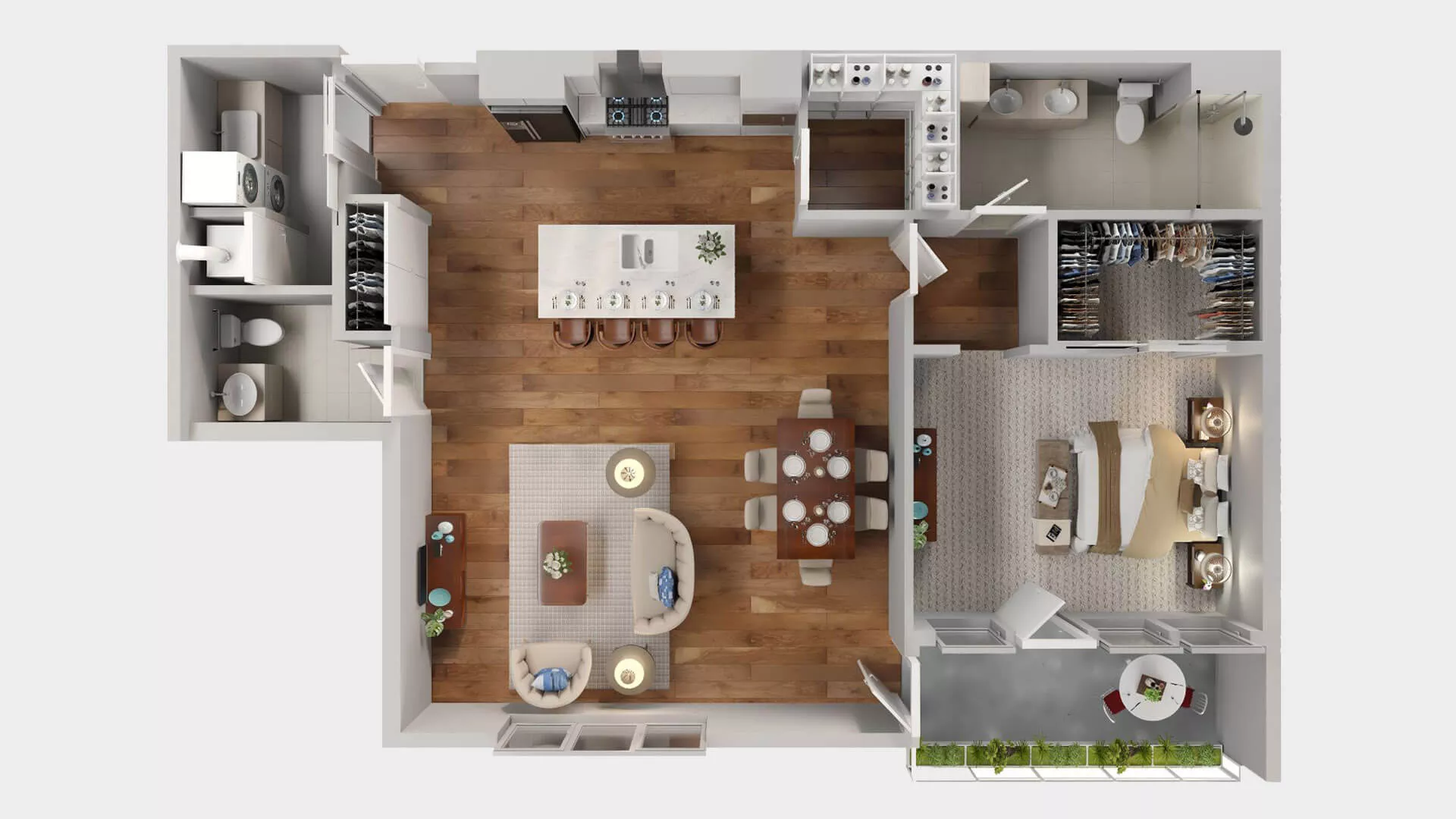
Top-down perspective floor plans sit at a slight angle above the room, giving spatial depth without the full volume of a true isometric view. They are well suited to MLS and portal listings where clarity and furniture legibility at small screen sizes are priorities. Illustrated floor plans use hand-drawn and graphic design techniques layered over a 3D base, producing a warmer, editorial-quality image preferred for premium print collateral and lifestyle brochures.
Photorealistic floor plan renders apply PBR-accurate materials, ambient occlusion shadows, and accurate furniture models to produce output that reads as a scaled-down version of a real room viewed from above.
Furnished versions show the space as a buyer would live in it. Unfurnished versions show clear room proportions, ADA clearances, and egress routes for planning submissions and HOA reviews.
Color-coded room plans assign distinct palette blocks to room categories for commercial leasing packs and investor decks.
Annotated and dimensioned plans add room labels, dimension lines, area schedules, north arrows, and legends to any of the above styles.
Multi-level floor plans and exploded axonometric views communicate building volume and vertical relationships across two or more floors in a single image. Cutaway building sections show the interior stack of a multi-level property from the side.
All styles can be combined in a single project brief and delivered as a coordinated visual set.
Why 3D Floor Plan rendering Matter in Real Estate Marketing and Architectural Communication
The gap between what a 2D drawing communicates to a trained professional and what a buyer, investor, planning officer, or design client needs to see in order to make a decision is wide. A 3D floor plan closes it entirely. That is not a vague benefit statement. It is a description of a specific information problem that has a direct cost when it goes unsolved.
The cost shows up in different ways depending on who is affected. A real estate agent whose listing includes only a 2D plan loses clicks and qualified inquiries to competitors with 3D visuals on the same portal. A developer whose pre-sale pack contains only schematic unit layouts generates fewer reservations and higher cancellation rates from buyers who committed without fully understanding the space. An architect whose client cannot read an elevation drawing wastes fee on revision rounds driven by misunderstanding rather than genuine design dissatisfaction.
3D floor plan rendering addresses all three problems at their root. It replaces the spatial literacy requirement with a visual that any viewer understands instantly. The commercial return on that improvement concentrates at three specific points in a project lifecycle: listing performance on property portals, pre-construction sales conversion, and design and planning approval speed.
A 3D floor plan set is one of the highest-return production investments in a pre-sale or planning-stage brief. RenderLand delivers furnished, dimensioned, annotated 3D floor plans formatted for US planning submissions, MLS standards, and digital campaign use.
RenderLand's 3D Floor Plan Rendering Production Process
The most common hesitation before commissioning a 3D floor plan rendering is uncertainty about inputs. What files do I need? What if my brief is incomplete? What happens at each stage? The process is straightforward, and understanding it before you start protects your budget and your deadline.
Source File Intake and Brief Review
You submit your spatial data in whatever format you have it: CAD plans in DWG or DXF, Revit (.rvt), SketchUp (.skp), PDF architectural drawings, or hand-sketched room measurements with dimensions noted. RenderLand reviews all submitted files and confirms the full brief: output style (isometric, perspective, illustrated, or photorealistic), furnished or unfurnished, color palette and brand guidelines, annotation requirements including room labels, dimension lines, area schedule, north arrow, and legend, and delivery format requirements covering JPEG, PNG, TIFF, PDF, SVG, and interactive web embed.
Production timeline, revision rounds, and milestone schedule are agreed in writing before work begins. Hand sketches and rough measurements are perfectly acceptable inputs. A polished CAD set is not a prerequisite for commissioning.
Base Plan Drafting and Geometry Verification
Architectural geometry is extracted or re-drafted from your submitted source files. Room dimensions, wall positions, door swing directions, window openings, and structural elements are verified for accuracy against your drawings. Scale is confirmed and the floor plan is structured in the target projection, whether top-down orthographic, isometric, or perspective.
A clean base outline draft is produced and sent to you for confirmation of spatial accuracy before any 3D modeling, furniture placement, or illustration work begins. This stage exists to catch dimension discrepancies early. A correction at base draft stage takes minutes. The same correction after full rendering is underway takes hours.
3D Modeling, Furniture Placement, and Material Application
The full 3D scene is constructed from the verified base plan. Furniture, fixtures, and fittings are placed at accurate scale from the studio asset library or from client-specified product references. Materials, flooring, and surface finishes are applied per the brief: hardwood, tile, carpet, stone, concrete, and soft furnishing textures all calibrated for visual accuracy at the output scale.
Ceiling heights and spatial volumes are modeled correctly for isometric and perspective projection outputs. For illustrated or top-down outputs, bespoke 2D illustration assets are produced over the 3D base. Because the same 3D scene can be output in multiple styles without re-modeling, multi-format delivery is efficient from a single scene build.
Lighting, Shadow, and Visual Style Pass
Ambient occlusion and soft drop shadow overlays are calibrated to create depth, spatial clarity, and visual weight in the rendered view. The color palette is applied to room surfaces, furniture, and flooring per brand guidelines or the agreed brief. The annotation layer is built at this stage: room labels, dimension lines, scale bar, north arrow, legend, area schedule, and any additional callouts per brief. Typography is set to client brand standards or studio defaults.
This stage is where the floor plan transforms from an accurate spatial document into a market-ready visual asset. Spatial accuracy and visual quality are both necessary. Neither alone is sufficient for a professional marketing deliverable.
Draft Delivery and Client Review
The first draft floor plan is delivered as a watermarked low-resolution proof via secure review link or annotated PDF. You review spatial accuracy, furniture layout and style, annotation content and labeling, visual style, color palette, and brand compliance. Feedback is submitted via email markup, annotated review PDF, or review portal.
All changes are captured in a single consolidated revision brief before production updates begin. Consolidated feedback protects your revision allocation and keeps the production timeline on track. Rolling individual change requests extend timelines and consume revision scope faster than a structured review process does.
Final Delivery and Format Export
Final floor plans are exported in all agreed formats: JPEG and PNG for web and portal upload, TIFF for print production, PDF for brochure and planning submission, SVG or EPS for vector and web interactive use. Print-ready files are delivered at 300 DPI minimum for brochure and display production. Web-optimized files are sized to MLS, Zillow, and portal upload specifications. Interactive floor plan versions in HTML embed format are delivered where specified in the brief. Source files and editable formats are available on request.
Benefits of 3D Floor Plan Rendering for Real Estate Agents, Developers, and Designers
Different buyers use 3D floor plan rendering to solve different problems. Here is what the service specifically delivers for the three main professional audiences we work with.
A furnished, dimensioned 3D floor plan in your listing package differentiates you immediately on two fronts. It signals marketing quality to buyers comparing listings on Zillow or Realtor.com, and it signals professional capability to seller clients evaluating agents at a listing appointment. Both matter commercially.
On the buyer side, a 3D floor plan pre-qualifies the viewing request. A buyer who has studied the spatial layout before calling already knows the room count is right, the flow works for them, and the proportions match what they are looking for. They arrive at the viewing with fewer basic questions and a higher likelihood of making an offer. On the seller side, a listing pack that includes a professional 3D floor plan is a concrete, visible demonstration of marketing investment that supports premium commission justification. Fewer wasted viewings. Faster offer timelines. A professional credential that travels beyond the single transaction.
Developers use 3D floor plans as the primary spatial communication tool across every pre-launch touchpoint. The sales center display wall. The investor information memorandum. The pre-sale brochure. The project website. Each of these requires a different format of the same floor plan content, and RenderLand delivers all of them from a single production brief.
A photorealistic, furnished floor plan set covering every unit type in a new development gives buyers the spatial confidence to reserve without visiting. For institutional investors and due diligence reviewers, an annotated 3D floor plan in a pitch deck communicates unit mix, circulation efficiency, and space quality at a glance. That immediate spatial legibility compresses due diligence timelines and reduces the volume of information requests the developer needs to respond to during a capital raise.
Architects and interior designers lose sign-off speed to a single consistent problem: the client cannot read the drawing. A furnished, proportionate, accurately scaled 3D floor plan of a proposed layout gives the client a complete, unambiguous picture of what they are approving. Every room is visible. Every furniture piece is in position. Every spatial relationship is clear.
Clients who can see the layout approve it faster and with fewer follow-up questions than clients who are working from elevations and sections they struggle to interpret spatially. That faster sign-off translates directly into a shorter path from design intent to procurement commitment and a reduction in the revision rounds driven by misunderstanding rather than genuine design preference. A professional 3D floor plan is also a portfolio asset produced as a byproduct of the client presentation process.
A 3D floor plan set is one of the highest-return production investments in a pre-sale or planning-stage brief. RenderLand delivers furnished, dimensioned, annotated 3D floor plans formatted for US planning submissions, MLS standards, and digital campaign use.
Problems 3D Floor Plan Rendering Solves for Your Project
These are the situations that most commonly drive a 3D floor plan rendering commission. If any of these describe your current challenge, the brief submission is the direct next step.
"2D Floor Plans Confuse Buyers and Slow Down the Sales Process"
Most buyers cannot translate a technical floor plan into a mental image of the finished space. They ask questions that a viewing would answer, book viewings for properties that do not actually fit their requirements, and make slower decisions because they lack spatial confidence. A photorealistic 3D floor plan removes the translation requirement entirely. The buyer sees the room, understands the layout, and self-qualifies before contact. The agent spends less time on unqualified inquiries and more time on buyers who are ready to make decisions.
"Real Estate Listings with Flat Plans Perform Poorly Against Competitors with 3D Visuals"
Portal algorithms and buyer behavior both favor listings with richer visual content. A listing with a furnished 3D floor plan records longer dwell times, higher click-through rates, and more qualified inquiries than a comparable listing with a flat 2D plan. In a competitive market where two similar properties are listed simultaneously, the one with the better visual content consistently attracts more viewing requests. The 3D floor plan is the most cost-effective single upgrade available to a listing's visual marketing package.
"Off-Plan and New Construction Sales Lack Credible Spatial Marketing Content"
A pre-construction sales campaign without spatial imagery is running at a structural disadvantage. Buyers comparing new construction options evaluate floor plans as the primary differentiator when no physical show home exists. A photorealistic furnished floor plan set converts a schematic unit layout into a home the buyer can picture living in. That emotional connection to the spatial reality of the unit is what drives reservation deposits, and it is only achievable through visualization, not through technical drawings.
"Investors and Institutional Buyers Cannot Evaluate Spatial Quality from Blueprints"
Institutional investors and private equity buyers conducting due diligence on a residential or commercial development need to assess unit mix, circulation efficiency, and space quality quickly across potentially hundreds of units. A set of annotated 3D floor plans with area schedules communicates all of this at a glance without requiring a site visit or a detailed drawing review. A pitch deck or investor memorandum that includes professional 3D floor plans compresses the due diligence timeline and signals the quality of the development team's communication standards.
"Interior Designers and Architects Lose Client Sign-Off on Layout Decisions"
A design sign-off meeting where the client cannot visualize the proposed layout from the drawings on the table rarely ends in a clean approval. It ends in requests for more samples, questions about furniture scale, and suggestions for changes that the designer knows will not improve the design but cannot easily disprove without visualization. A furnished 3D floor plan presented at the sign-off meeting gives the client a complete spatial picture of the proposal. Layout approvals happen faster, with fewer condition-based revisions, when the client can see what they are being asked to confirm.
"Planning and HOA Submissions Lack Spatial Clarity for Reviewers"
Planning officers and HOA architectural review committee members review submissions from applicants with widely varying levels of drawing quality and communication skill. A submission that includes a professionally annotated, dimensioned 3D floor plan immediately signals competence and transparency. The reviewer understands the proposal without having to request clarification. Faster reviewer comprehension reduces the risk of an information request that pauses the approval timeline and adds weeks to the project programme.
"Property Brochures and Marketing Collateral Look Generic and Underperform"
A developer brochure built around a 2D floor plan and a site photograph looks like every other developer brochure in the market. It does not differentiate the product. A photorealistic 3D floor plan with brand-integrated typography, a custom color palette, and lifestyle furniture placement transforms the same spatial data into a premium marketing asset. The same floor plan information, presented in a visually distinguished format, elevates the perceived quality of the development and the credibility of the developer's marketing standards.
"Remote and International Buyers Cannot Understand the Spatial Offer Without Visiting"
Overseas investors and remote buyers evaluating US properties without the ability to visit in person rely entirely on digital materials to assess spatial quality and layout logic. A furnished 3D floor plan with accurate room proportions, dimension annotations, and area schedules provides the spatial information needed to make a reservation decision from any location in the world. Combined with a set of interior renders, a 3D floor plan eliminates geography as a barrier to buyer commitment in pre-construction and off-plan sales campaigns.
Industries RenderLand Serves with 3D Floor Plan Rendering Services
3D floor plan rendering is relevant to any project where a space needs to be understood by an audience that is not trained to read technical drawings. Here is the range of sectors we work across.
Residential real estate agents and brokerages are among the most frequent buyers of 3D floor plan services. MLS-ready furnished plans, portal-optimized files, and social media crops are standard deliverables for single-property listing campaigns. Agents who include professional 3D floor plans in their listing packages consistently differentiate on marketing quality against competitors using flat 2D drawings.
Luxury and custom home developers use high-resolution illustrated plans and isometric projections for premium buyer packs and architect review board presentations. Multi-family and apartment developers receive coordinated unit-type plan sets with building core plans and site plan companions, formatted for pre-sale brochures, investor information memoranda, and sales center digital displays. Vacation rental and short-stay operators use furnished 3D floor plans in Airbnb and VRBO listings, guest guide inserts, and house manual layouts to improve booking inquiry rates and reduce guest orientation questions on arrival.
Real estate investment trusts and REITs use dimensioned plans and area schedules for asset summaries and due diligence packs. Property marketing agencies commission print-ready, web-ready, and social media format floor plan sets as campaign production assets across multiple development projects.
Commercial real estate and office developers use annotated, color-coded leasing pack plans and tenant fit-out guide drawings to support tenant attraction campaigns and lease negotiation processes. Hospitality clients including hotels, resorts, and branded residences use room-type plans, floor layout diagrams, and amenity plans for brand standard documentation and investor pitch materials. Retail and mixed-use developments rely on unit plans, public realm layouts, and signage overlay plans for tenant leasing packs and planning submissions.
Interior design studios use furnished FF&E overlay plans and material color plans for client design approval and procurement briefing. Architecture and design firms use 3D floor plans for competition boards, illustrated planning packs, and dimensioned section plans. Healthcare facilities require zoned plans, ADA accessibility route plans, and room schedules for planning board and board approval submissions, where spatial clarity and annotation accuracy are submission requirements rather than presentation preferences.
Why Clients Choose RenderLand for 3D Floor Plan Rendering Services
There are a lot of floor plan providers in the market, including automated generators, offshore services, and general graphic design studios. Here is what distinguishes RenderLand for buyers who have used other options and know what to look for.
RenderLand 3D floor plans are built to dimensional accuracy from the submitted source file. Room areas are calculated correctly. Annotation standards are professional and submission-ready. The output meets MLS portal upload compliance requirements, Zillow and Realtor.com format specifications, planning board spatial documentation standards, and NAR industry guidelines for floor plan disclosure.
Buyers who have received a floor plan from a low-cost provider and had it rejected by an MLS portal or questioned by a planning officer understand immediately why production standards matter. A floor plan that fails at the point of submission or upload has no commercial value, regardless of how attractive it looks. RenderLand floor plans are built to the standards that matter in the field, not just the standards that look good in a portfolio.
The full spectrum of acceptable inputs runs from fully coordinated Revit BIM models to rough hand-sketched room measurements with approximate dimensions noted on a photograph. That input flexibility means any buyer can commission, regardless of where they are in the design or development process. No CAD file, no problem. A sketch and a set of measurements is a valid brief.
The output spectrum covers every format required for every distribution channel. Photorealistic, illustrated, isometric, annotated, furnished, unfurnished, branded, multi-level, and interactive. Print-ready for brochure. Web-optimized for portal. Social media crops for advertising. Interactive embed for website. All from one production brief, one production run, and one coordinated delivery package.
A 3D floor plan set is one of the highest-return production investments in a pre-sale or planning-stage brief. RenderLand delivers furnished, dimensioned, annotated 3D floor plans formatted for US planning submissions, MLS standards, and digital campaign use.
3D Floor Plan Rendering Portfolio
 01
01
 02
02
 03
03


3D Floor Plan Services
Frequently Asked Questions For 3D Floor Plan Rendering Services
Pricing is driven by six main factors: the number of floors in the property, the number of distinct unit types in a multi-unit development, the output style selected (photorealistic, illustrated, isometric, or annotated line), the level of furniture and FF&E detail, the annotation scope required, and whether interactive delivery is included. As a directional guide: a single-level residential floor plan in a standard furnished photorealistic style typically starts in the $150 to $400 range. A multi-unit development set covering four to six unit types with multi-format delivery runs $800 to $2,500. Commercial and hospitality projects with custom annotation, area schedules, and branded styling are quoted individually. A project-specific quote is returned within 24 to 48 hours of brief submission.
A single-level residential floor plan with a clean brief and standard furniture placement typically takes two to four business days from brief confirmation to first draft. A multi-unit, multi-level development set with custom annotation, branded styling, and multi-format delivery runs five to ten business days. The milestone structure is: brief intake and base plan verification, 3D modeling and draft production, client review, revision, and final export. The base plan verification stage is where most timeline extensions occur on complex projects. Submitting clean, accurately dimensioned source files shortens this stage significantly.
We accept CAD plans in DWG and DXF, Revit .rvt files, SketchUp .skp files, ArchiCAD .pln files, PDF plans and elevations, and hand-sketched room measurements with dimensions noted. Hand sketches are fully acceptable. You do not need a digital drawing file to commission. Supplementary materials that accelerate production quality include brand guidelines and color palette references, furniture style preferences or specific product references, annotation requirements and labeling conventions, and reference floor plans showing the visual style you are targeting. The brief intake process identifies exactly what is needed for your specific scope.
The main style options and their best-fit contexts are: photorealistic furnished floor plans for premium residential and luxury property marketing where lifestyle appeal and material richness are priorities; isometric projection for brochures and marketing packs where spatial volume needs to be communicated in a single image; illustrated and color-coded plans for commercial leasing packs, investor decks, and planning submissions where data legibility takes priority; and black-and-white annotated line plans for HOA submissions and technical planning packs. Mixed-style delivery, for example photorealistic for web portal use and annotated dimensioned for planning submission, is available from a single production brief and is the most common approach for developer clients who need floor plans across multiple distribution channels.
Yes. Once the 3D scene is built and the furnished version is approved, producing an unfurnished version requires asset removal from the existing scene rather than a scene rebuild. This is a common request from developers who need furnished plans for marketing materials and unfurnished dimensioned plans for planning or HOA submissions. The most cost-efficient approach is to agree on both versions at brief stage rather than requesting the unfurnished version after furnished delivery is complete. Both versions are then produced from the same verified scene at the same time, avoiding a separate revision allocation.
Yes. An interactive floor plan can be delivered as an HTML embed with clickable room hotspots that display room names, dimensions, and linked interior renders or photography. Third-party platform integration via Floorplanner, Metropix, or RoomSketcher is also available where the client's website platform is compatible. Interactive floor plan scope is a distinct production deliverable that is agreed and scoped at brief stage. It is not an automatic upgrade from a static floor plan delivery. The client's web platform needs to support iframe or JavaScript embed, which the majority of modern property website platforms do. If you are unsure about your platform's compatibility, we can advise at brief stage.
Print-ready files are delivered as TIFF and PDF at 300 DPI minimum, covering brochure, advertising, and large-format display production. Web and portal files are JPEG and PNG sized to Zillow, Realtor.com, and MLS portal upload specifications. Vector files in SVG and EPS format are delivered for web interactive embedding and design studio editing workflows. Social media crops in 1:1 square, 4:5 portrait, and 9:16 vertical are delivered at platform-optimized resolution for Instagram, Facebook, and LinkedIn advertising. Animated floor plan in MP4 format is delivered for digital signage and social video where included in the brief. All formats come from a single production run with no re-rendering cost for multi-format delivery.
Yes. Multi-level plans covering ground, first, second floors, basement, and rooftop terrace are produced as a coordinated set from the same building model, ensuring consistent visual style, scale, annotation standards, and brand treatment across all levels. Multi-unit developments are typically priced by unit type count rather than total unit count, because one unit type can be mirrored, rotated, or reflected from a single base model. Site plan and building core plans are available as companion deliverables for multi-unit and commercial development sets, providing the complete spatial document suite needed for investor information memoranda and planning submissions.
Yes. RenderLand delivers floor plans in formats and resolutions that comply with Zillow floor plan upload specifications, Realtor.com listing image requirements, and standard MLS portal upload standards. Portal compliance is built into the delivery brief as a default. Floor plan disclaimer language and Fair Housing Act compliant room labeling are considerations the studio is aware of and can address in annotation production where required. If your MLS has specific technical requirements beyond standard portal specifications, share them at brief stage and we will build them into the output format.
Yes. The 3D scene built for a floor plan is the same foundational asset used for interior render production and virtual tour development. The geometry, room layout, and basic materials are already in place from the floor plan production. Interior render production adds camera-level lighting, PBR material detail, and post-production compositing to the existing scene, which is significantly more cost-efficient than starting a separate interior render brief from scratch. If interior renders or a virtual tour are likely future requirements, noting this at brief stage allows the modeling pipeline to be structured for dual output from the start.
Request a Quote from RenderLand
Commission Your 3D Floor Plan Project
RenderLand produces accurate, market-ready 3D floor plans that give real estate agents the listing visuals to outperform competitors on Zillow, developers the pre-sale imagery to sell units before construction completes, and architects the spatial communication tools to win client sign-off before procurement begins. That is the service, and that is the commercial outcome it delivers.
Submitting a brief gets you three things: a structured review of your source files and project scope, a realistic production timeline built around your deadline, and a project-specific price proposal returned within 24 to 48 business hours with no obligation to proceed. Upload a floor plan, a sketch, or a PDF drawing. Share a project brief link. Or book a short discovery call. We work with every file format from Revit models to hand-written room measurements, and we serve architects, developers, real estate agents, and design firms across all 50 US states.
Quotes returned within 24–48 business hours. All file formats accepted — including hand sketches.
Studio: RenderLand — 3D Floor Plan Services | United States | Fully Remote Production